
Back in January, I interviewed and was selected for the position of First Sergeant at my Air Force installation. A First Sergeant is a time honored role with a rich history dating back to its beginnings during the Revolutionary War, however the role was officially established in 1949. The Air Force First Sergeant works for their unit’s commander and is a focal point for readiness, morale, personnel heath and well-being, and quality of life issues within their respective unit. Most importantly, the First Sergeant epitomizes the best qualities of Air Force Senior Non-Commissioned Officers.
The journey to becoming a First Sergeant in the Air Force is extensive. Airmen must attain either the rank of Technical Sergeant (E-6), promotable to Master Sergeant (E-7), or have already gained the rank of Master Sergeant, to even apply for an open position. That means there’s likely a minimum of 12 years in service to even apply, not counting the numerous military education and training required to serve in those aforementioned ranks. First an airmen must apply and interview to be put into a pool of potential First Sergeants. Most airmen have served in “Additional Duty” roles supporting their unit’s current First Sergeant before applying. After being accepted into the pool, airmen go through a grueling interview process to be deemed suitable to serve in the position. The last step is to interview with the unit commander and other senior leadership where the opening is.
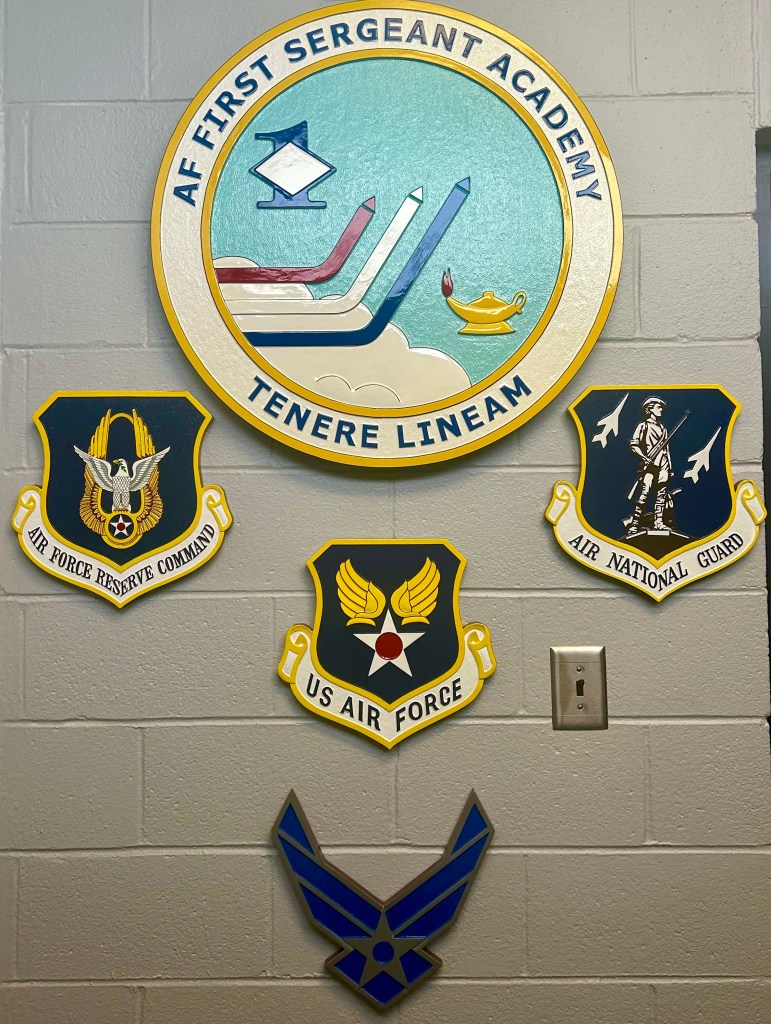
And this is where the picture above comes in. You’ve made it. You were selected as the next unit First Sergeant at your home installation. But wait, you’re not done. After selection, you must head down to Montgomery, Alabama, to Maxwell Air Force Base, to attend First Sergeant Academy, which trains and prepares you for your new role as First Sergeant. What you see when you walk up the stairs to earn your diamond, which is the Air Force’s symbol of the First Sergeant, is a picture of a total force (Active Duty, Guard, and Reserve) of “shirts” (the unofficial nickname of the First Sergeant).
As for the main circular symbol. Inside the cloudy sky is the 1 and diamond, the obvious and aforementioned symbol of the First Sergeant. The three stripes in red, white, and blue. Yes, the colors of America come to mind, but the signify the three ranks a first sergeant can hold as a Master Sergeant, Senior Master Sergeant, and Chief Master Sergeant. Last, the learning lamp. This highlights the continuous pursuit by shirts to never stop learning about and taking care of the people they oversee. Mission readiness is as much mental as it is physical, and a shirt who refuses to be complacent is one who paves the path for their airmen.
Finally, the phrase “Tenere Lineam”. The translation from its original Latin is to hold the line. Funny thing, my first tattoo was also Latin (Quod in vita facimus in aeternum resonat (What we do in life echoes in eternity). Anyway, holding the line in a literal, military sense is to defend your position during battle. As it relates to a First Sergeant, us diamonds are the cog in the system in maintaining and upholding the standards of the United States Air Force. I take immense pride in wearing that diamond. It’s a great honor, and I cannot wait to get to work for my airmen.
Shirt out.
 Military Dad Strength
Leave a comment